
Key Tips to Avoid Common Customs Documentation Mistakes
When you're shipping to the US from Canada, handling various customs documents is part of the process. Errors in these documents can cause border delays, additional fees, and shipment rejections. Taking the time to understand the required paperwork — and keeping it accurate — helps your freight clear customs without unnecessary complications.
Whether you're shipping a single pallet or managing weekly cross-border LTL freight, accurate customs documentation is the foundation of on-time delivery. This guide covers the most common errors and how to prevent them.
Quick Navigation
- Common Customs Documentation Mistakes
- How to Prepare Your Customs Documents Correctly
- Understanding Key Customs Forms
- Canada-Specific Customs Documents: CCI, PARS, PAPS & CARM
- Importance of Accurate Valuation
- How to Work with Customs Brokers
- Frequently Asked Questions
- Let CSA Transportation Handle Your Customs Documentation
Common Customs Documentation Mistakes to Avoid
Incorrect Tariff Classification
The tariff classification determines how much duty you pay on goods crossing the border. Each item is assigned a unique code, and misclassifying an item — even selecting a code for a similar product — can result in customs holding the shipment until the correct classification is provided.
Tip: Always verify the classification code before shipping. Refer to updated tariff schedules or consult a qualified professional to confirm accuracy.
Missing or Incorrect Harmonized Code
The Harmonized System (HS) Code is essential for classifying goods in international trade and determines the correct tariff applied to your products. Every product has a unique code based on its type and composition.
If the HS Code is missing or incorrect, customs may not process your shipment — resulting in delays at the border.
Tip: Confirm the correct HS Code for each item and verify it matches your paperwork before the shipment leaves your facility.
How to Prepare Your Customs Documents Correctly
Verify Commercial Invoice Accuracy
The commercial invoice is one of the most important documents for customs clearance. Any errors can delay your shipment or trigger additional inspections.
Commercial Invoice Checklist
Product Descriptions
Accurate descriptions that match the tariff code list
Declared Value
Correct value for each item, including all applicable charges
Country of Origin
Correct country where goods were manufactured or produced
Sender & Receiver Details
Full names, addresses, and contact information for both parties
Payment Terms
Correct Incoterms and payment conditions
HS Codes
Correct Harmonized System code for each product line
Double-Check Shipment Details
Before submitting your shipment for customs clearance, verify that all shipment details are complete and consistent across your documents.
Recipient Information
Confirm the full name, address, and contact details of the receiver.
Matching Descriptions
Goods descriptions on the shipping label must match the commercial invoice.
Declared Value
The declared value must reflect the true worth of the items being shipped.
Understanding Key Customs Forms
Bill of Lading (BOL)
The Bill of Lading serves three critical functions in cross-border shipping:
Customs Declaration Forms
Customs declaration forms provide essential details about goods being imported or exported, including value, quantity, and product type. Customs authorities use these forms to:
- Determine applicable duties and taxes
- Verify compliance with import/export regulations
- Confirm that goods match the accompanying documentation
Different forms apply depending on the country and shipment type. Always confirm you are using the correct form for your specific shipment.
Important: All information on the BOL must match your commercial invoice and customs declaration. Discrepancies between documents are one of the most common reasons for shipment holds at the Canada-USA border.
Canada-Specific Customs Documents
Cross-border freight between Canada and the United States requires specific documentation beyond the standard commercial invoice and BOL. Missing or incomplete submissions are a frequent cause of border delays for LTL shipments.
Canada Customs Invoice (CCI)
The Canada Customs Invoice is used for northbound shipments entering Canada. It includes details about the goods, their value, country of origin, and the terms of sale. While a standard commercial invoice may be accepted, the CCI provides the specific fields CBSA requires — including currency of sale, which Canadian law mandates.
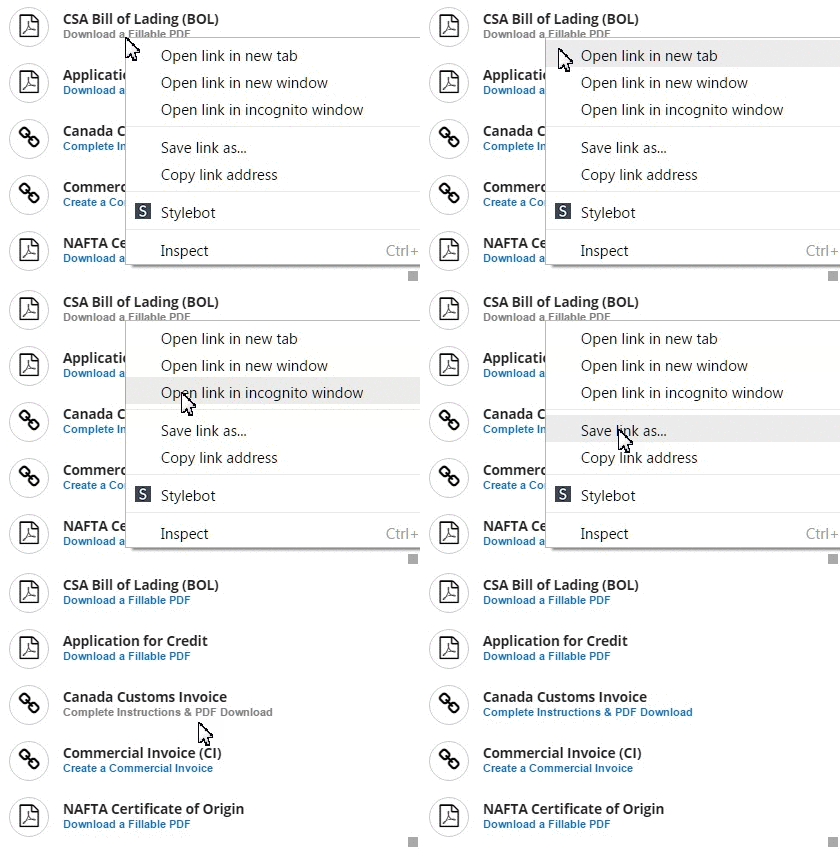
CSA provides a downloadable CCI form. See our Customs & Cross Border Shipping resource page for all required forms.
USMCA Certificate of Origin
If your goods qualify for preferential duty treatment under the USMCA (known as CUSMA in Canada), a Certificate of Origin is required to claim reduced or duty-free rates. Without this certificate, full duty rates apply — even if your goods would otherwise qualify.
The certificate can be submitted up to 90 days after customs clearance, but providing it at the time of shipment avoids paying duties upfront and requesting a refund later.
PARS & PAPS Pre-Clearance
Pre-clearance systems allow your customs broker to begin processing shipments while freight is still in transit, reducing border wait times.
PARS (Pre-Arrival Review System) — Used for northbound shipments entering Canada. Your customs broker submits documentation to CBSA before the truck arrives at the border.
PAPS (Pre-Arrival Processing System) — Used for southbound shipments entering the United States. Works similarly to PARS but is administered by U.S. Customs and Border Protection (CBP).
CSA coordinates PARS and PAPS submissions with your customs broker to ensure pre-clearance is completed before your freight reaches the border.
CARM: CBSA Assessment and Revenue Management
As of October 2024, CBSA requires importers to use the CARM portal to manage their financial security and submit payment for duties and taxes on goods entering Canada.
If your CARM account is not properly set up or your financial security is not in place, your goods may not be released from customs — even if all other documentation is correct.
Action Required: If you import goods into Canada, verify that your business is registered in the CARM portal and that your financial security (such as a surety bond or deposit) is active. Consult your customs broker for assistance with CARM setup.
Importance of Accurate Valuation
Customs authorities use the declared value of goods to calculate the correct duty and tax. Inaccurate valuation — whether intentional or accidental — can result in delays, fines, or shipment seizure.
How to Calculate Shipment Value
The total value of goods includes more than just the purchase price. When calculating the declared value, include:
- The price paid for the goods
- Shipping and freight charges
- Insurance costs
- Any other charges contributing to the final price
Keeping clear transaction records helps support accurate declarations and smooth customs processing.
Avoid Over- or Under-Valuing Goods
Undervaluing goods to reduce duties may result in penalties, fines, or shipment holds by customs authorities.
Overvaluing goods means paying more in duties than necessary, directly impacting your bottom line.
Always use the correct invoice price and include all associated charges. Accurate valuation keeps your shipment moving and avoids costly penalties.
How to Work with Customs Brokers
For shippers managing regular cross-border freight, partnering with an experienced customs broker reduces the risk of errors and delays.
Benefits of Hiring a Customs Broker
Accurate Documentation
All paperwork is prepared and submitted correctly, reducing the risk of holds or rejections.
Regulatory Awareness
Brokers stay current on changes to tariffs, regulations, and compliance requirements — including CARM and USMCA updates.
Fewer Delays
Proper preparation — including PARS/PAPS pre-clearance — means fewer surprises at the border and faster clearance times.
Choosing the Right Customs Broker
When selecting a customs broker, consider the following:
- Industry Experience — Do they understand your product type and regulatory requirements?
- Regional Knowledge — Are they experienced with Canada-USA cross-border freight specifically?
- Responsiveness — Can they resolve issues quickly when problems arise at the border?
- CARM Readiness — Can they assist with CARM portal registration and financial security requirements?
- Service Scope — Do they handle the volume and complexity your operations require?
A knowledgeable customs broker with cross-border expertise helps your goods clear customs without delays or unexpected costs.
Frequently Asked Questions
Incomplete or inconsistent documentation is the leading cause. Discrepancies between the commercial invoice, Bill of Lading, and customs declaration — such as mismatched product descriptions, incorrect HS Codes, or inaccurate values — frequently result in shipments being held for review.
A licensed customs broker is authorized to act as your agent with customs authorities and formally clear goods on your behalf. A customs coordinator, such as CSA Transportation, manages the documentation process and works alongside licensed brokers to keep your paperwork accurate and your shipments moving. Both roles help reduce errors, but they serve different functions in the clearance process.
The Canada Border Services Agency (CBSA) maintains an online tariff lookup tool, and the Canadian Customs Tariff schedule is available through the CBSA website. For U.S.-bound shipments, the U.S. International Trade Commission provides the Harmonized Tariff Schedule (HTS). If you are uncertain about the correct code, consulting a licensed customs broker is recommended.
Shipments can be held for document review, inspection, or missing paperwork. Depending on the issue, resolution may require corrected documentation, additional information, or payment of outstanding duties.
Working with a carrier that operates bonded warehouse facilities — such as CSA Transportation — provides a safety net. When paperwork issues arise, freight can be moved in-bond to a secure facility rather than sitting at the border while documentation is resolved.
PARS (Pre-Arrival Review System) allows your customs broker to pre-clear shipments with the CBSA while the freight is still in transit. The PARS number — also known as a Cargo Control Number (CCN) under the ACI system — is a reference number used by the carrier and broker to identify the shipment to Canada Customs.
Without a valid PARS submission, your freight cannot clear the border and will be held until pre-clearance is completed. CSA coordinates PARS submissions with your customs broker so your freight can be loaded once an acceptance to cross is received from the CBSA.
A USMCA (CUSMA in Canada) Certificate of Origin is required if you want to claim preferential duty-free or reduced-duty treatment on qualifying goods shipped between Canada and the United States. While it is not required for every shipment, failing to provide one when your goods qualify means you will pay full duty rates unnecessarily.
The certificate can be submitted up to 90 days after customs clearance, but providing it at the time of shipment avoids paying duties upfront and requesting a refund later.
CARM (CBSA Assessment and Revenue Management) is a portal system that modernizes how importers pay duties and taxes on goods entering Canada. Since October 2024, importers are required to use the CARM portal to manage their financial security and submit payments.
If your CARM account is not properly set up, your goods may not be released from customs even if all other documentation is correct. Consult your customs broker for assistance with CARM registration and financial security requirements.
Yes. CSA Transportation operates as a customs coordinator, assisting with the preparation and management of cross-border documentation. Our team helps verify that your paperwork is complete and consistent before your shipment reaches the border, reducing the risk of delays.
For full details on required documents — including downloadable BOL, CCI, and commercial invoice forms — visit our Customs & Cross Border Shipping resource page.
Let CSA Transportation Handle Your Customs Documentation
Accurate customs documentation is the foundation of reliable cross-border freight. Mistakes cause delays, extra fees, and shipment rejections — all of which are preventable with proper preparation.
Why CSA Transportation
CSA Transportation provides customs coordination services backed by PIP-accredited, customs-bonded terminal facilities. Our team manages the documentation process with attention to detail — coordinating PARS/PAPS submissions with your customs broker and helping your freight clear the border efficiently.
PIP Accredited
Trusted Trader status with CBSA
Bonded Facilities
In-bond safety net for paperwork issues
Documentation Support
PARS/PAPS coordination with your broker
No Fuel Surcharges
The rate you're quoted is the rate you pay
Get a Quote for Your Cross-Border Shipment
Whether you're shipping a single pallet or managing regular cross-border lanes, our team can help ensure your documentation is accurate and your freight moves without delays.
Or call us: (416) 754-0999
Author

Matt enjoys exploring creative ways to connect people through marketing, with a particular passion for sales, marketing automation, and AI. At CSA Transportation, he works on branding, content strategy, automation, SEO and campaigns that help tell CSA's story. From website updates to email designs, Matt brings ideas to life while keeping the bigger picture in mind.